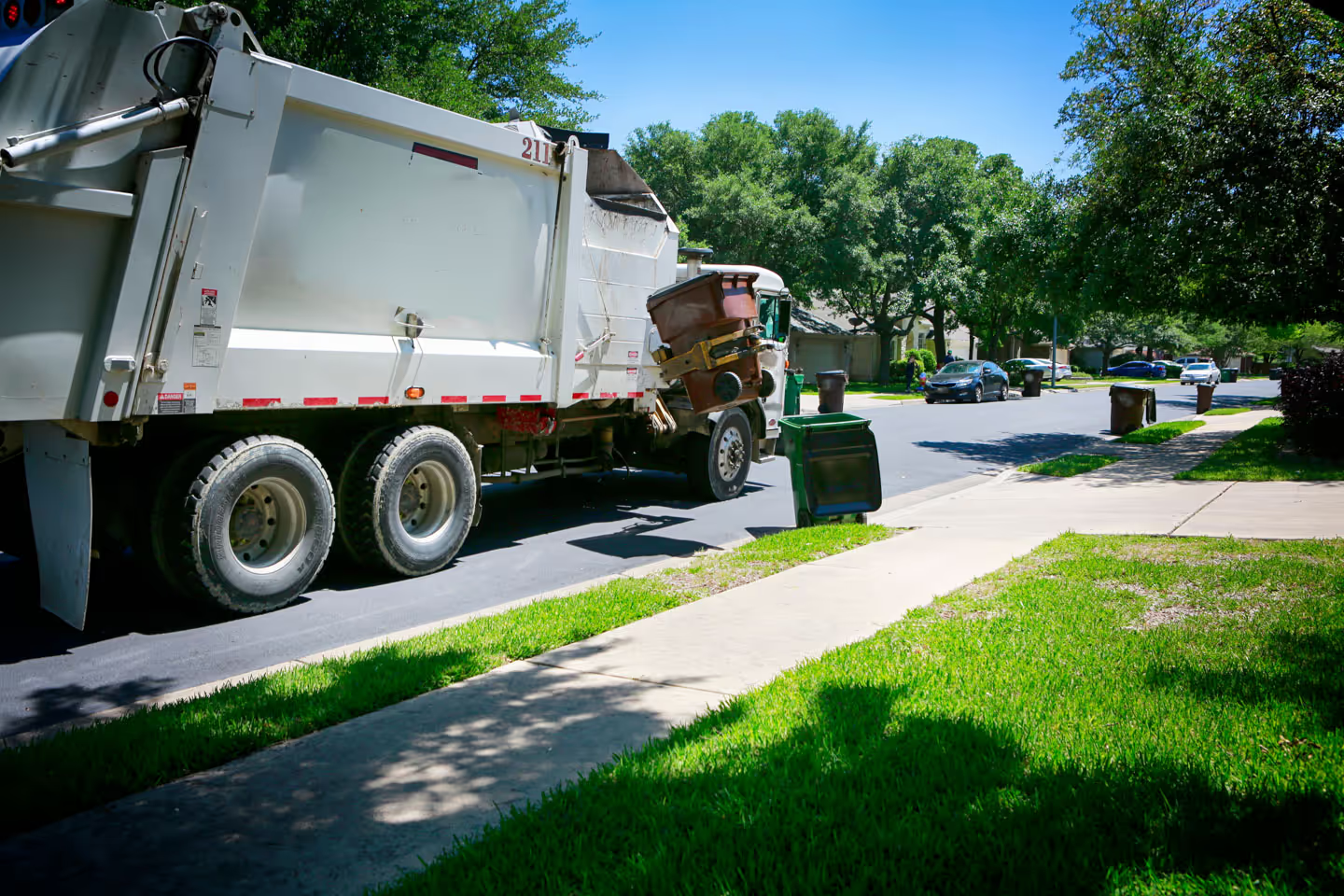
Garbage Truck Accident Lawyers
A garbage truck is one of the heaviest vehicles on a residential street, and it spends the day stopping, backing, and pulling out near driveways, mailboxes, and people. If one hits you, your car, or someone you love, Ali Law Group reviews your case for free and explains your options, including whether the truck belonged to a city or a private company.
Hit by a Garbage Truck?
Collection routes run early, often before it is fully light,
and the trucks work in tight spaces: alleys, cul-de-sacs, and streets lined with parked cars.
Drivers back up, make wide turns, and stop in the lane at every house.
The people around them include pedestrians, cyclists, other drivers, and the crew members riding on or walking beside the truck.
The first thing that matters in these cases is who was running the truck.
A garbage truck might belong to a city, to a private hauling company,
or to a company hired by a city to do the work—each of those changes who you make a claim against and what rules apply.
City Truck or Private Hauler?
If the truck belonged to a city, your claim is governed by the Texas Tort Claims Act, which sets a few rules that don't apply to private companies:
- A city can be held responsible when an employee, acting within the scope of the job, causes harm by operating a motor-driven vehicle.
- The amount you can recover from a city is capped by law at $250,000 per person and $500,000 per incident for injury or death.
- The city generally has to receive written notice of your claim within six months of the incident, and a city's own charter or ordinance can set a different notice period. We check for it right away.
If the truck belonged to a private hauler,
the company can generally be held responsible for what its drivers do on the job, and the cap above does not apply.
The hauler's insurance is usually where a claim starts.
Some cities hire private companies to collect trash.
When that is the case, the contract between the two decides a lot, and we read it early.
Who May Be Responsible
- The driver. A driver who backed up without checking, ran a light, or was looking at a phone can be responsible for the crash.
- The company or city that employed the driver. That includes a hauler's failure to train, supervise, or screen the people it puts behind the wheel.
- A maintenance company. If failed brakes or a hydraulic arm that let go played a part, whoever serviced the truck may share the blame.
- A manufacturer. A defect in the truck, the lift, or the compactor can lead to a product liability claim.
- A contractor. When one company hires another to run a route, both may be involved.
What We Ask Them to Keep
Many waste trucks carry cameras, and most keep route and stop records.
We ask the hauler or city to preserve any video, the route sheet for that day,
GPS or telematics data, the driver's training and discipline file, and the truck's maintenance and inspection records.
A city may also have to respond to a public records request.
Whether a given truck has any of this varies, and we won't know until we ask.
If You Work on a Garbage Truck
A crew member hurt on the job is in a different situation from a member of the public.
Rules for workplace injuries depend on whether the employer carries workers' compensation.
A private employer that doesn't can lose some of its
legal defenses.
See our pages on workplace injuries and
non-subscriber cases.
Common Injuries in Garbage Truck Crashes
A garbage truck outweighs most of what it hits, and people on foot or bikes have no protection at all.
Crush injuries, broken bones, and head injuries are common.
Some crashes cause a traumatic brain injury or a
spinal cord injury, and the most serious lead to a
catastrophic injury that needs care for life.
If someone you love died in a crash, see our page on wrongful death.
If You Were Partly at Fault
If the other side says you share the blame, your recovery drops by your percentage of fault, and
past 50 percent you recover nothing.
Prior results do not guarantee a similar outcome. Every case is decided on its own facts.
Deadline to File a Lawsuit
Texas gives you two years from the crash
to file suit, and a child's clock runs differently.
If a city truck was involved, the six-month notice described above comes first.
Why People Call Ali Law Group
- The review is free, and you pay nothing unless we win your case. That covers attorney's fees and case expenses such as court costs, experts, and records.
- Your attorney's phone number. Every client gets their attorney's personal phone number, and our attorneys are available by phone 24/7.
- Hablamos español. Our attorneys work with clients in Spanish, Arabic, Hindi, Urdu, Punjabi, French, and Italian, and we arrange an interpreter for other languages.
- Offices in Texas, and you can reach us by phone from anywhere.
Meet Our Attorneys


Practice Areas


Garbage Truck Accident FAQs


Hurt in a Crash With a Garbage Truck?
Tell us what happened. We'll review your case for free and explain what your options may be.

This website is designed for general information only. The information presented at this site should not be construed to be formal legal advice nor the formation of a lawyer/client relationship.